ASIC vs FPGA: Choosing Custom Silicon
An ASIC is fixed-function silicon built for one job at massive scale; an FPGA is reconfigurable hardware you can rewire after it ships. How to choose.
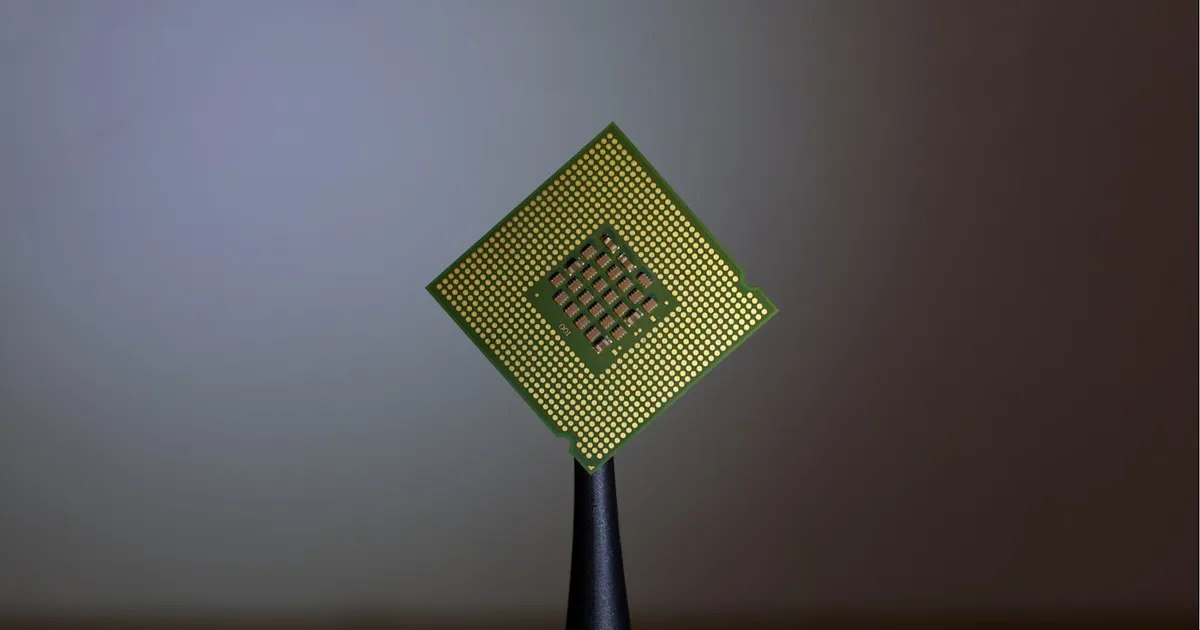
An ASIC (application-specific integrated circuit) is a chip designed and manufactured to do one job, with its logic etched permanently into silicon, while an FPGA (field-programmable gate array) is a chip full of reconfigurable logic blocks that can be rewired after manufacturing — and sometimes rewired again in the field, long after it ships.
Two different ways to build custom logic
Both chips exist for the same reason: general-purpose CPUs and even GPUs execute a fixed instruction set, and some workloads run faster, cooler, or cheaper on hardware built to match the algorithm rather than the other way around. An ASIC gets there by hard-wiring the exact logic gates a task needs, laid out at fabrication time and unchangeable afterward. An FPGA gets there by shipping a grid of generic, uncommitted logic blocks and programmable interconnects, then configuring — “programming,” though no software runs in the traditional sense — that grid into whatever circuit the task needs, using a hardware description language like Verilog or VHDL.
The result is a real tradeoff. An ASIC dedicated to one function is faster and more power-efficient per operation than an FPGA configured to do the same thing, because every transistor on an ASIC serves that one function, while an FPGA spends a meaningful fraction of its silicon on the reconfigurable interconnect fabric itself — overhead the ASIC never pays. But that efficiency is locked in at manufacturing time: an ASIC can’t be changed after fabrication without spinning an entirely new chip, while an FPGA’s configuration can be reloaded in the field, sometimes in milliseconds.
Cost structure and the volume question
The economics split sharply on production volume. Designing an ASIC involves a fixed, substantial non-recurring engineering cost — architecture, verification, and the photomask set needed for fabrication — that has to be paid once regardless of whether you make a thousand chips or a hundred million. Spread across enough units, that fixed cost per chip becomes negligible, which is exactly why every high-volume consumer product with custom silicon — phone SoCs, and increasingly AI inference accelerators alongside general-purpose TPUs — uses ASICs.
FPGAs avoid that upfront cost entirely: you buy an off-the-shelf reconfigurable chip and program it yourself, with no mask set and no fabrication run of your own. But the per-unit cost of an FPGA is higher than an equivalent ASIC at any meaningful volume, because the FPGA vendor is amortizing its own general-purpose chip across many different customers’ designs rather than one customer’s dedicated silicon. The crossover point varies by design complexity and market, but the shape of the tradeoff is consistent: FPGAs win at low volume and when requirements might still change; ASICs win once volume is high and the design has stabilized.
ASIC vs FPGA
| ASIC | FPGA | |
|---|---|---|
| Reconfigurability | None — fixed at fabrication | Fully reconfigurable, even after deployment |
| Performance per watt | Highest for its specific task | Lower — pays overhead for reconfigurable fabric |
| Upfront cost | High (design, verification, mask set) | Low — off-the-shelf part |
| Per-unit cost at scale | Very low at high volume | Higher, doesn’t fall the same way with volume |
| Time to market | Slow — full design and fabrication cycle | Fast — reprogram and deploy |
| Best fit | Stable, high-volume, well-understood workloads | Evolving designs, prototyping, low-to-mid volume, hardware that must update in the field |
Where each shows up in practice
ASICs dominate anywhere a well-understood function runs at enormous scale: cryptocurrency mining hardware, video codecs baked into phones and cameras, and increasingly AI accelerators purpose-built for a specific class of model, once that class has stabilized enough to justify the design and fabrication commitment. FPGAs show up where flexibility matters more than peak efficiency: telecom equipment that needs to support evolving protocol standards, aerospace and defense hardware where field updates are required and re-fabrication isn’t an option, and as a prototyping and validation step before a design is stable enough to commit to an ASIC.
That last use case — prototyping on an FPGA before committing to an ASIC — is common enough to be a standard part of the custom-silicon development pipeline: get the logic right and validated on reconfigurable hardware first, where mistakes cost a re-flash rather than a new fabrication run, then commit the finalized design to an ASIC once volume and stability justify the fixed cost.
The takeaway
An ASIC trades flexibility for maximum efficiency at a fixed design, paid for with a large upfront cost that only makes sense at high volume. An FPGA trades some of that efficiency for the ability to reconfigure the hardware after it ships, at a lower upfront cost and a higher per-unit price. Choose an ASIC once a workload is stable and the volume is high enough to amortize the design cost; choose an FPGA when requirements are still evolving, volume doesn’t justify a fabrication run, or the hardware needs to be updatable after it’s already deployed.
Tagged
Keep reading
 Chisato · · 4 min read
 Wafer-Scale Integration Explained
Wafer-scale integration builds one giant chip from an entire silicon wafer instead of cutting it into dies. How it works and its tradeoffs.
Chisato · · 4 min read What Is Semiconductor Yield?
Yield is the share of chips on a wafer that work. It's the single biggest driver of chip cost, and why new process nodes start out expensive.
 Chisato · · 5 min read
 2.5D vs 3D Chip Packaging Explained
2.5D packaging places dies side by side on an interposer; 3D packaging stacks dies vertically through silicon vias. How advanced packaging works.