What Is a System on Chip (SoC)? Hardware Explained
A system on chip packs a CPU, GPU, memory controller, and other components onto one die — the design behind phones, laptops, and most modern chips.
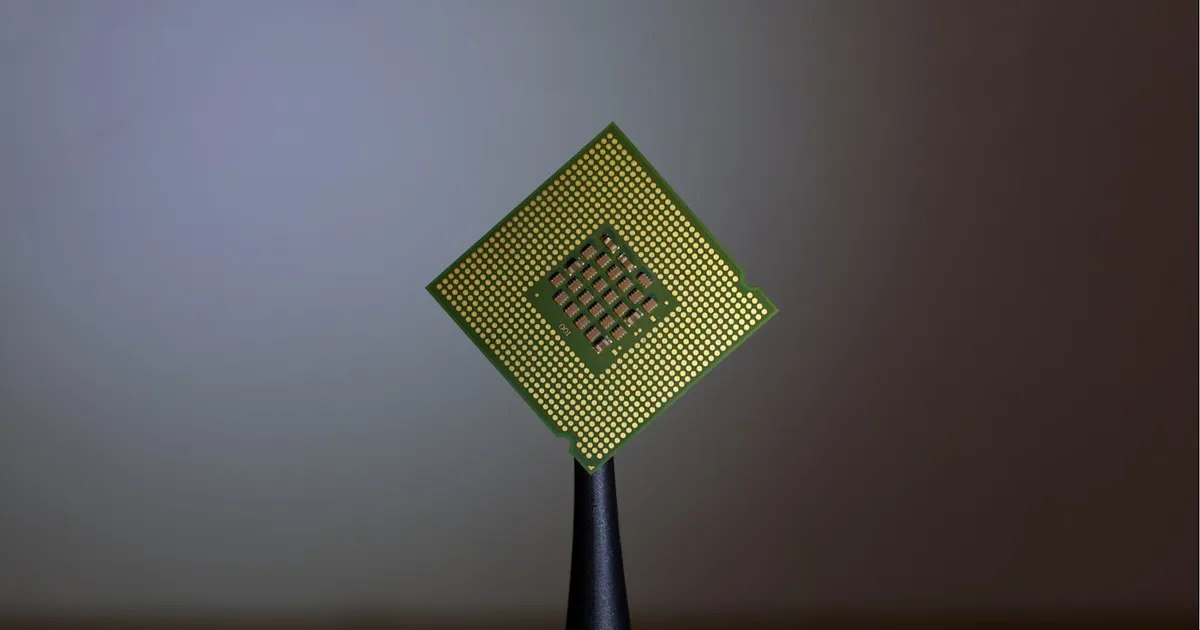
A system on chip, or SoC, integrates most of the components a computer needs — a CPU, a GPU, memory controllers, I/O interfaces, and often specialized accelerators — onto a single piece of silicon instead of spreading them across separate chips on a circuit board. It’s the dominant design for phones, tablets, and increasingly laptops and servers, because putting everything on one die shrinks size, cuts power consumption, and reduces the physical distance signals have to travel between components.
What “system on chip” actually bundles
A traditional desktop PC keeps its major components physically separate: a CPU socketed onto the motherboard, a discrete GPU on its own card, memory on separate DIMMs, and a chipset handling I/O — each connected by traces and buses across the board. An SoC instead integrates the equivalent of most of those pieces into one package:
- CPU cores — the general-purpose processing cores, handling most application logic.
- GPU — an integrated graphics processor, sharing the same die and often the same memory pool as the CPU.
- Memory controller — the interface to RAM, physically close to the compute cores it serves.
- I/O controllers — USB, display output, storage interfaces, and networking logic.
- Specialized accelerators — increasingly, a dedicated NPU for machine learning workloads, an image signal processor for camera pipelines, and security enclaves for cryptographic operations.
Not every SoC includes every one of these, and the exact mix varies by target device, but the defining trait is integration: components that would otherwise be separate chips share one die or one tightly packaged module.
Why integration matters
Three practical benefits drive the shift toward SoCs:
- Power efficiency — moving data between separate chips costs more energy than moving it within a single die, because off-chip signaling has to drive longer traces and cross more electrical boundaries. For battery-powered devices, this difference is the whole ballgame.
- Physical size — a phone has no room for a discrete GPU card and a separate memory controller chip. Integration is what makes a smartphone’s compute stack fit into a few square centimeters.
- Latency — the CPU, GPU, and memory controller sitting physically close together, often sharing the same pool of memory, cuts the delay of moving data between them compared to communicating across a board-level bus.
The tradeoff is flexibility: a discrete GPU can be upgraded independently of the CPU; an SoC’s GPU is fixed at manufacturing time as part of the whole package. This is a large part of why SoCs dominate mobile and embedded devices, where upgradability was never the priority, while high-end desktops and servers needing maximum, swappable GPU performance still often favor discrete components.
SoC vs chiplet designs
SoCs and chiplets are sometimes confused because both aim to pack more capability into a tightly integrated package, but they take opposite approaches to manufacturing. A traditional monolithic SoC fabricates all its components on one continuous piece of silicon in a single manufacturing pass. A chiplet design instead manufactures separate small dies — potentially on different process nodes, from different fabs — and packages them together afterward, connected by extremely short, high-bandwidth on-package interconnects.
Modern high-end designs increasingly blend the two ideas: a “chiplet-based SoC” achieves SoC-like integration and shared packaging while gaining the manufacturing flexibility of building each functional block separately and combining them at the packaging stage rather than forcing everything through one monolithic die.
SoC vs CPU vs GPU: what’s actually inside
It helps to be precise about the containment relationship, since these terms get used loosely:
| Term | What it refers to |
|---|---|
| CPU | A processor core (or set of cores) for general-purpose computation |
| GPU | A processor specialized for parallel, throughput-oriented work like graphics and matrix math |
| SoC | A package containing a CPU, often a GPU, and supporting components, all on one integrated die |
An SoC isn’t a competing category to a CPU or GPU — it’s a container that includes them. Asking “is this chip an SoC or a CPU” is a bit like asking whether a car is an engine or a vehicle: the CPU is a component the SoC contains, alongside several others.
Memory architecture: unified vs discrete
Because an SoC’s CPU and GPU typically share the same physical memory pool — unlike a discrete GPU with its own separate VRAM — SoCs commonly use a unified memory architecture. Both processors read and write the same RAM without needing to copy data back and forth across a bus, which speeds up workloads that pass data between CPU and GPU stages frequently, like video encoding or on-device machine learning inference. The tradeoff is that CPU and GPU compete for the same fixed memory bandwidth rather than each having dedicated capacity, which is why memory bandwidth — often provided by fast, tightly integrated memory like HBM in higher-end designs — is such a closely watched spec for SoC performance.
The takeaway
A system on chip integrates a CPU, often a GPU, memory controllers, and I/O logic onto a single die, trading the modularity of discrete components for lower power draw, smaller size, and shorter data paths. It’s the standard design for phones and increasingly laptops, where a unified memory pool speeds up CPU-GPU data sharing at the cost of fixed, shared bandwidth. Chiplet-based designs are blurring the line further, delivering SoC-style integration while manufacturing each functional block separately for flexibility.
Tagged
Keep reading
 Chisato · · 5 min read
 What Is a Memory Controller?
A memory controller is the circuit that manages every read and write between the CPU and main memory, setting the ceiling on bandwidth and latency.
 Chisato · · 4 min read
 What Is a DPU (Data Processing Unit)?
A DPU is a specialized chip that offloads networking, storage, and security tasks from the CPU. How data processing units fit alongside CPUs and GPUs.
Chisato · · 4 min read What Is a Semiconductor Process Node?
A process node like '5nm' or '3nm' names a chipmaker's manufacturing generation, not a literal measurement anymore. Here's what the number means.