ASML Q2 2026 Earnings: Sales Beat, Guidance Raised
ASML posted €9.3B in Q2 net sales and lifted its full-year outlook to €43–45B on strong AI chip demand. Here are the numbers and what to watch next.

The most important supplier in the chip industry just told investors the AI buildout is accelerating, not cooling. On Wednesday, July 15, 2026, ASML Holding NV reported second-quarter net sales of €9.3 billion and net income of €2.9 billion, beating its own guidance, and — for the second time this year — raised its full-year outlook. Shares of the Dutch lithography giant jumped more than 7% at the open before paring to about 6%, and the report offered a jolt of relief to a semiconductor sector still nursing wounds from a brutal June selloff.
The quarter, by the numbers
ASML’s Q2 came in ahead of the range management had guided. Key figures from the release:
- Net sales: €9.3 billion, up from €8.8 billion in the first quarter and above the guided range of €8.4 billion to €9.0 billion.
- Net income: €2.9 billion, with basic earnings per share of €7.59.
- Gross margin: 54.0%, at the high end of expectations.
- Installed Base Management sales: €2.8 billion, the service-and-upgrade business that was the single biggest driver of the upside.
Quarterly net sales (€B)
Q1 2024 – Q2 2026 actuals · Q3 2026 shown at guidance midpoint
The hairline marks the year-ago (Q2 2025) level; the dashed column is the midpoint of ASML’s Q3 guidance. Every figure is in the table below. Source: ASML quarterly results.
That last line matters more than it looks. ASML sells a small number of extraordinarily expensive machines, so quarter-to-quarter revenue can swing on the timing of a handful of shipments. The strength in installed base — servicing and upgrading the tools already sitting in customers’ fabs — signals that existing capacity is running hot, a real-time read on how hard chipmakers are pushing their lines to keep up with AI demand.
Laid out quarter by quarter, the reacceleration is visible — a slow start to 2024, a step up through 2025, and now guidance implying the steepest quarter in the company’s history:
| Quarter | Net sales (€B) | YoY | Net income (€B) | Gross margin |
|---|---|---|---|---|
| Q1 2024 | 5.29 | −21.6% | 1.22 | 51.0% |
| Q2 2024 | 6.24 | −9.5% | 1.58 | 51.5% |
| Q3 2024 | 7.47 | +11.9% | 2.08 | 50.8% |
| Q4 2024 | 9.26 | +28.0% | 2.69 | 51.7% |
| Q1 2025 | 7.74 | +46.4% | 2.36 | 54.0% |
| Q2 2025 | 7.69 | +23.2% | 2.29 | 53.7% |
| Q3 2025 | 7.52 | +0.7% | 2.13 | 51.6% |
| Q4 2025 | 9.72 | +4.9% | 2.84 | 52.2% |
| Q1 2026 | 8.77 | +13.2% | 2.76 | 53.0% |
| Q2 2026 | 9.33 | +21.2% | 2.92 | 54.0% |
| Q3 2026 (guided) | 11.0–12.0 | ~+53% | — | 55–57% |
Source: ASML quarterly results. ASML's revenue is lumpy quarter to quarter — it sells a small number of very expensive machines — so the year-over-year column is the cleaner read.
The outlook raise is the headline
The bigger news was the guidance. ASML now expects full-year 2026 net sales of €43 billion to €45 billion, with a gross margin of 54% to 56%. That is a substantial step up from the €36 billion to €40 billion range the company carried earlier in the year — roughly a 16% increase at the midpoint — and the second upward revision of 2026.
2026 full-year net sales guidance (€B)
Three guidance ranges given this year — raised twice
The July raise lifted the midpoint by roughly €6B versus April — about 16% — after 2025 closed at €32.7B. Source: ASML guidance.
For the third quarter, ASML guided net sales of €11.0 billion to €12.0 billion and a gross margin of 55% to 57%, implying a sharp sequential acceleration into the back half of the year.
Gross margin (%)
Q1 2024 – Q2 2026 · Q3 2026 guided to 55–57%
Q2’s 54.0% came in well above the 51–52% ASML had guided, and Q3 guidance steps up again. Every figure is in the ten-quarter table above. Source: ASML quarterly results.
CEO Christophe Fouquet framed the demand in unusually direct terms, flagging “extremely strong” order intake tied to AI chips. “Customers in turn continue to accelerate their capacity expansion plans,” he said, “providing ASML with increased visibility into longer-term demand.” For a company whose backlog stretches years into the future, visibility is the currency that matters most.
Why ASML is the tell
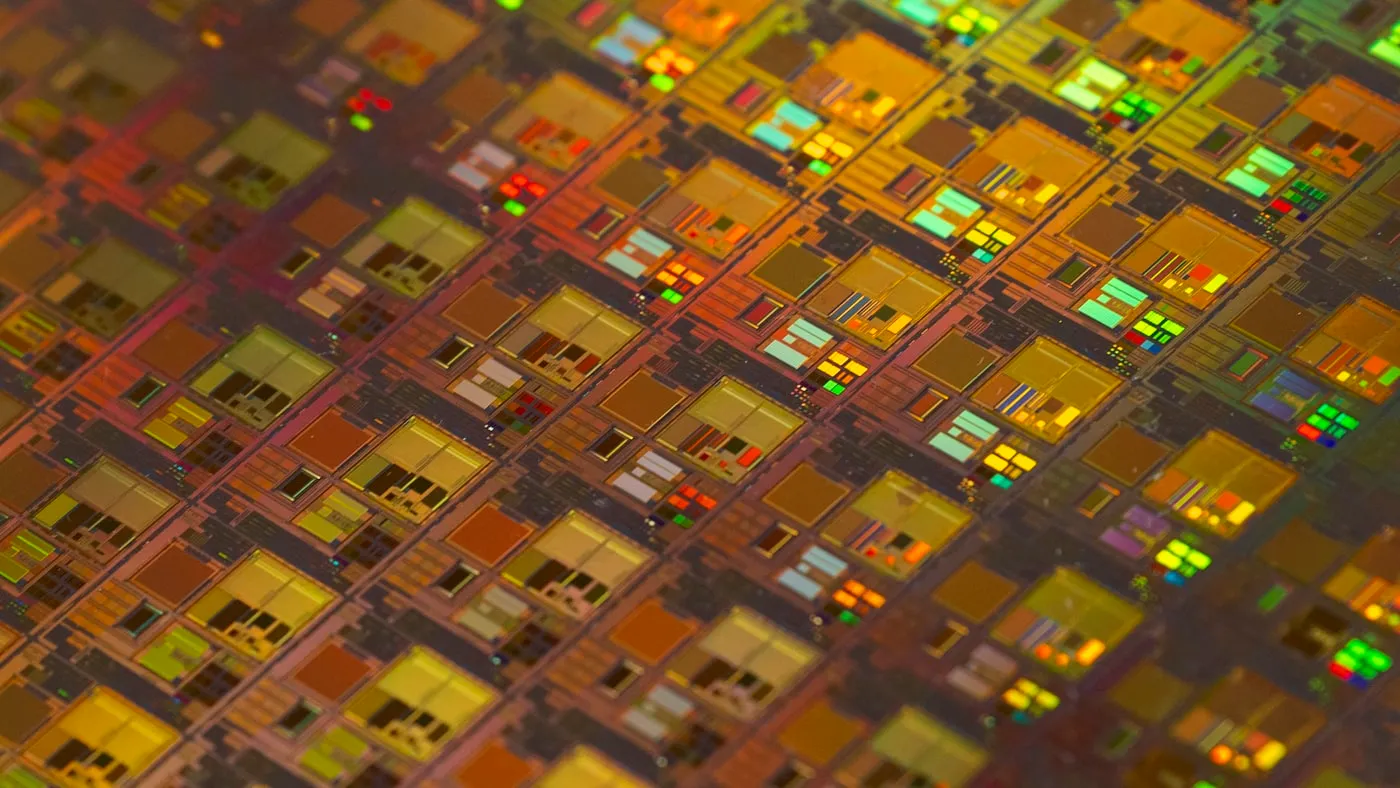
ASML occupies a chokepoint unlike any other in technology. It is the only company in the world that makes extreme ultraviolet (EUV) lithography machines — the room-sized, nine-figure systems required to print the smallest, most advanced transistors. Every leading-edge processor from Nvidia, AMD, Apple, and the memory makers ultimately depends on ASML tools somewhere in the production chain.
That monopoly makes ASML’s order book a leading indicator for the entire industry. When foundries and memory producers commit to buying more EUV capacity, they are betting real capital — years in advance — that chip demand will be there to fill it. An upgraded ASML forecast is therefore a supply-side vote of confidence that ripples out to chip designers like Nvidia, Broadcom, and AMD, and it is exactly the kind of signal that can trigger a broad re-rating of semiconductor shares.
The timing amplified the effect. The results landed while the sector was reeling: the chip-stock selloff that erased trillions in value since late June had left investors questioning whether AI-driven demand was as durable as the multiples implied. ASML’s report was the first hard data point of earnings season to push back on that anxiety, and it arrived one day before TSMC’s own second-quarter results — the two companies together viewed as the clearest read on global semiconductor demand.
2027 already filling up
Fouquet also offered a rare window into next year. ASML is “close to receiving all the orders it needs” for 2027, he said, even as the company plans to add about 30% more EUV capacity versus 2026. In practice, that means the machines ASML will build and ship next year are already largely spoken for — a backlog dynamic that Bank of America had flagged going into the print, noting it expected the 2027 order book to be effectively full before management even reported.
That is the crux of the bull case. The current wave of AI infrastructure spending — the hyperscaler capex boom driving data-center construction — converts into orders for the leading-edge logic and high-bandwidth memory that only EUV can produce at scale. As long as that spending holds, ASML sits at the narrow end of the funnel.
China, tariffs, and High-NA
Two perennial questions hung over the quarter. On China, CFO Roger Dassen said the region remains roughly 20% of total net sales — though he noted that percentage now applies to a higher revenue base than the company had expected earlier in the year, meaning the absolute dollar contribution is larger even as the share holds steady. China has been a swing factor for ASML throughout the export-control era, and its stabilization removes one source of uncertainty.
Fouquet also highlighted progress on High-NA EUV, ASML’s next-generation lithography platform. He cited Intel now using High-NA in production on its most advanced products — calling it an important milestone and “proof of the maturity of the tool.” Intel’s adoption, alongside its broader capacity expansion push, is a meaningful validation for a system that carries an even higher price tag than standard EUV and had faced questions about how quickly customers would ramp it.
What it means
ASML’s report reframes the debate that has gripped chip investors all summer. The June selloff was built on a fear that AI demand was outrunning its economic justification — that capex commitments would be trimmed and the order pipeline would thin. A second guidance raise in a single year, from the one company with perfect visibility into what chipmakers are actually buying, is the strongest evidence yet that the buildout still has momentum.
Who wins. The most direct beneficiaries beyond ASML are the leading-edge foundries and memory makers whose expansion plans the guidance implies — and, one step downstream, the chip designers whose parts those fabs will produce. A “fully booked 2027” is a tailwind for Nvidia’s next-generation roadmap, for AMD’s data-center accelerators, and for the memory suppliers riding the AI memory supercycle. Intel’s High-NA validation is a quieter win, giving the company a credible claim to process leadership on its most advanced nodes.
What to watch. The bull case now rests on a specific proposition: that end demand for AI compute justifies the capacity being ordered years ahead. Three things will test it. First, TSMC’s Q2 results on Thursday — a matching signal from the world’s largest foundry would confirm the read; a cautious tone would undercut it. Second, whether the hyperscalers’ own capex guidance holds through their upcoming earnings, since ASML’s backlog is only as durable as their spending. Third, the memory cycle: with HBM4 supply still racing to catch up, any air pocket in memory pricing would ripple back up the chain.
For now, the tell has spoken. The single most upstream company in the AI hardware stack looked at its order book and raised its numbers — again. In a sector where sentiment had turned fearful, that is the clearest counterargument bulls have had all month. Whether it marks the bottom of the summer chip correction or merely a pause in it is the question the rest of earnings season will answer.
Tagged
Keep reading
 Kurumi · · 5 min read
 Marvell Q2 Earnings: Record $2.74B, Raised Guidance
Marvell posted record Q2 FY2027 revenue of $2.74B on a 46% data center surge, raised its outlook again, and guided Q3 to $3.15B. The numbers and what they mean.
 Kurumi · · 5 min read
 SMIC Q2 2026 Earnings: Profit Jumps 262%, Stock Rises
SMIC's Q2 profit surged 262% to $479M as revenue rose 36% and margins expanded, sending the Chinese foundry's Hong Kong shares up as much as 6.4%.
Kurumi · · 5 min read Applied Materials Q3 2026 Earnings: Record Revenue Beat
Applied Materials posted a record $9.12B in Q3 revenue, up 25%, and guided Q4 to $10.25B as AI chip demand lifts its 2026 equipment outlook above 30%.