CPU Instruction Pipelining Explained
Instruction pipelining overlaps a CPU's fetch, decode, and execute stages so multiple instructions are in flight at once. How it works.
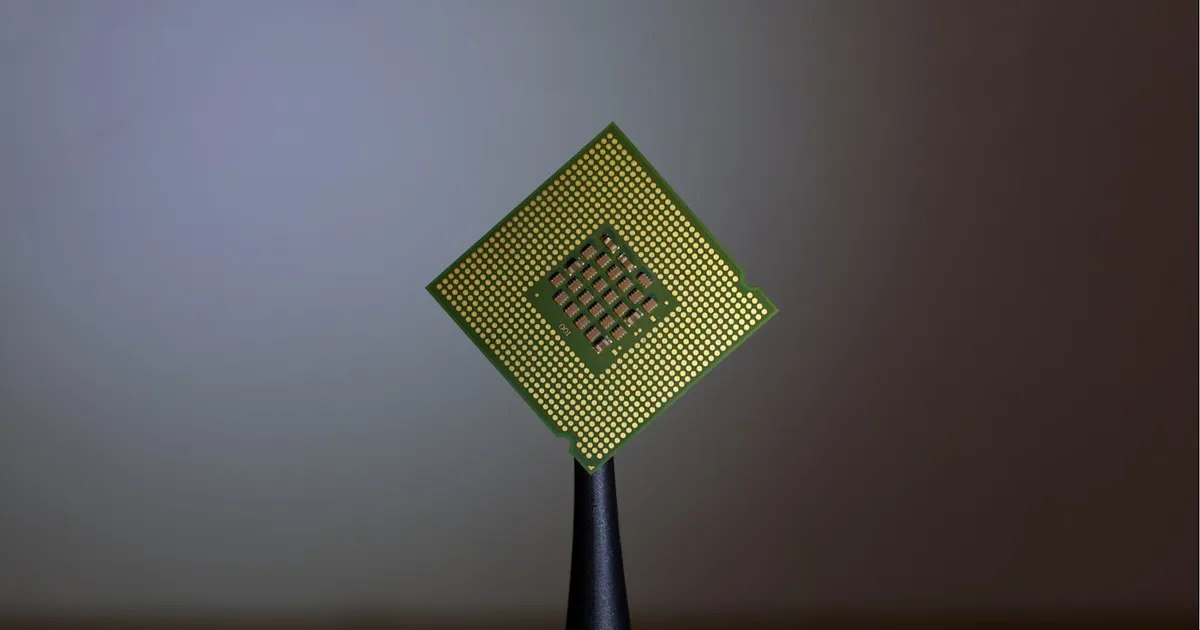
Instruction pipelining is a CPU design technique that splits instruction execution into discrete stages — fetch, decode, execute, and so on — and overlaps them, so the processor is working on several instructions simultaneously, each at a different stage, rather than finishing one instruction completely before starting the next.
The effect is similar to an assembly line: no single instruction finishes any faster, but the CPU’s overall instruction throughput goes up dramatically, because a new instruction can enter the pipeline every clock cycle instead of waiting for the previous one to fully complete.
The classic five-stage pipeline
A simplified textbook pipeline, close to the one used in early RISC designs, breaks instruction execution into five stages:
- Fetch (IF) — retrieve the next instruction from memory (typically the instruction cache).
- Decode (ID) — interpret the instruction’s opcode and read the register values it operates on.
- Execute (EX) — perform the actual computation, usually in the arithmetic logic unit.
- Memory access (MEM) — read from or write to memory, for instructions that touch it (a load or store).
- Write-back (WB) — write the result back to a register.
Without pipelining, an instruction runs through all five stages before the next one starts, so completing five instructions takes 25 cycles (five stages, five cycles each). With pipelining, once the pipeline is full, a new instruction finishes every single cycle — the same five instructions take roughly nine cycles: five to fill the pipeline plus four more as each subsequent instruction’s remaining stages overlap with the one ahead of it. The throughput gain scales with pipeline depth, though real chips balance depth against the hazards described below rather than pipelining as deeply as physically possible.
Hazards: what breaks the overlap
Pipelining’s efficiency depends on each stage being able to proceed without waiting on the others, and three categories of hazard threaten that assumption:
- Structural hazards occur when two instructions need the same hardware resource in the same cycle — for instance, if instruction fetch and a data memory access both need the same memory port. Modern designs address this mostly by duplicating resources, such as separate instruction and data caches.
- Data hazards occur when an instruction depends on the result of one still in the pipeline ahead of it. If instruction two needs a register that instruction one hasn’t written back yet, naively reading it produces a stale value. Forwarding (or bypassing) — routing a result directly from the execute stage of one instruction to the decode stage of the next, without waiting for write-back — resolves most of these without stalling. When forwarding can’t help, such as immediately after a load instruction, the pipeline inserts a stall (a bubble) to wait.
- Control hazards occur at branches. The pipeline doesn’t know which instruction to fetch next until the branch condition is resolved, which happens several stages after the branch itself was fetched. This is the hazard branch prediction exists to address — guessing the branch outcome and speculatively continuing down the predicted path rather than stalling until the answer is known for certain.
Deeper pipelines, and their limits
Increasing pipeline depth — more, narrower stages — generally allows a higher clock frequency, since each stage does less work per cycle. This was the dominant strategy for raising CPU performance through the 1990s and early 2000s, with some designs reaching twenty or more stages.
Depth has real costs, though. A mispredicted branch flushes every instruction currently in the pipeline behind it — the deeper the pipeline, the more wasted work a misprediction costs. Deeper pipelines also increase the number of hazards that need forwarding paths or stall logic to resolve correctly, adding design complexity. And beyond a certain point, the power cost of the additional pipeline registers and control logic outweighs the frequency gain, which is part of why chip design shifted from chasing raw clock speed toward extracting more work per cycle through techniques like out-of-order execution, wider SIMD execution, and simultaneous multithreading instead.
Pipelining vs superscalar execution
Pipelining alone increases throughput by overlapping stages of sequential instructions, one at a time entering the pipeline per cycle. Superscalar designs go further, fetching and issuing multiple instructions per cycle into multiple parallel execution units. The two techniques are complementary rather than competing — nearly every modern general-purpose CPU, whether x86 or ARM, is both deeply pipelined and superscalar, combining stage overlap with multiple-instruction-per-cycle issue to extract as much instruction-level parallelism as the hazards in a given instruction stream allow.
The takeaway
Instruction pipelining overlaps a CPU’s fetch, decode, execute, memory, and write-back stages across multiple in-flight instructions, turning a design that would otherwise finish one instruction every several cycles into one that can retire close to an instruction per cycle. Structural, data, and control hazards are what limit how cleanly that overlap works in practice, and forwarding, stalling, and branch prediction are the mechanisms that keep the pipeline full despite them. It’s one of the foundational ideas behind essentially all modern CPU performance, underneath the newer techniques — superscalar issue, out-of-order execution, deep speculation — built on top of it.
Keep reading
 Chisato · · 4 min read
 Thermal Interface Materials Explained
Thermal interface material fills microscopic gaps between a chip and its heatsink so heat can actually transfer to the cooler.
Chisato · · 4 min read Clock Speed vs. IPC: What Actually Makes a CPU Fast
Clock speed measures cycles per second; IPC measures work done per cycle. Real CPU performance is the product of both, not either one alone.
 Chisato · · 4 min read
 UMA vs NUMA: Memory Architecture Explained
UMA gives every CPU core equal-latency memory access; NUMA gives each core faster access to its local memory bank. How the two architectures differ.