SIMD and Vectorization Explained
SIMD lets a CPU apply one instruction to multiple data points at once. How vectorization works, why compilers auto-vectorize loops, and its limits.
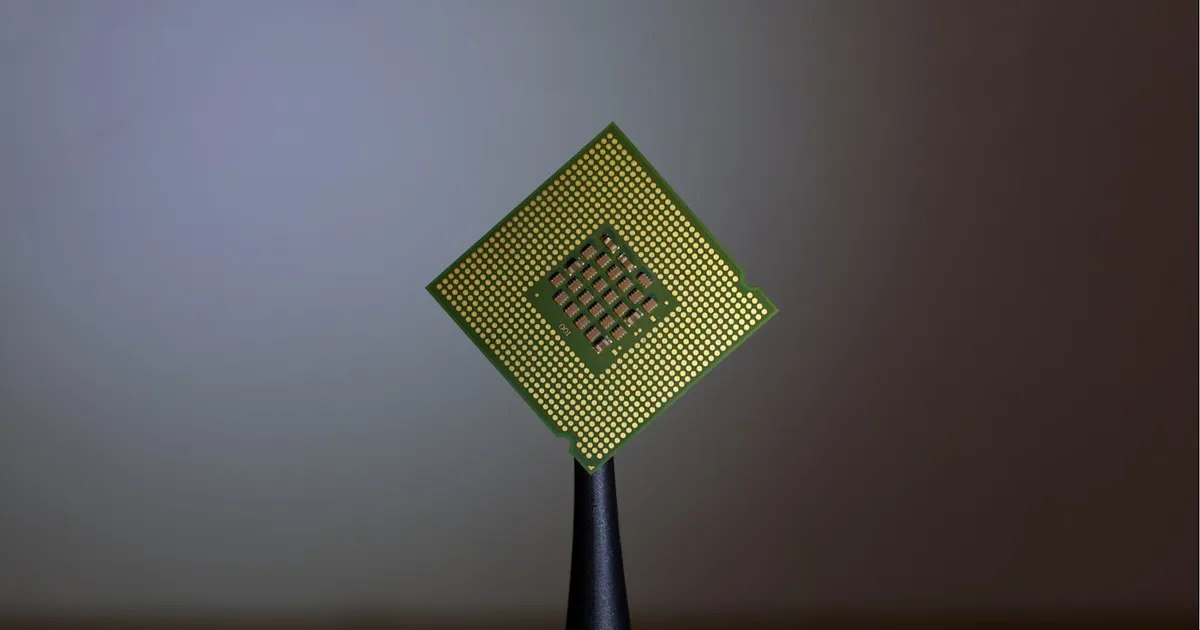
SIMD — Single Instruction, Multiple Data — is a CPU execution model where one instruction operates on several data elements simultaneously, instead of the usual one-instruction-one-value model. Vectorization is the process of transforming ordinary scalar code into SIMD instructions that exploit this. Together they’re one of the main reasons a modern CPU core can be dramatically faster than a naive instruction-count comparison would suggest.
Scalar vs vector execution
A conventional scalar instruction processes one value: add register A to register B, store the result. A SIMD instruction packs several values — say, eight 32-bit floats — into a single wide register and performs the same arithmetic operation on all eight at once, in roughly the time a scalar instruction takes to process one.
Scalar: for each of 8 floats, one ADD instruction each → 8 instructions
SIMD:   pack 8 floats into one register, one ADD instruction → 1 instruction
This only works when the same operation applies uniformly across a contiguous run of data — which turns out to describe an enormous amount of real-world computation: adding two arrays element-wise, applying a filter to every pixel in an image, computing dot products, running the same activation function across a tensor’s worth of values.
Where SIMD shows up in real hardware
Every mainstream CPU architecture has SIMD instruction set extensions — wider vector register sets bolted onto the base instruction set over successive hardware generations, each generation typically widening the registers and adding new operations. On the x86 side these extensions have grown from 128-bit registers to 256-bit and 512-bit widths across generations; ARM has its own comparable SIMD extensions, including versions with variable vector lengths that let the same compiled instruction run efficiently across chips with different physical register widths.
GPUs push the same underlying idea much further. A modern GPU is built around executing the same instruction across thousands of data lanes in parallel — architecturally closer to SIMD taken to its logical extreme than to a general-purpose CPU core, which is exactly why GPUs excel at the kind of uniform, data-parallel workloads (rendering, and now much of AI training and inference) that SIMD was designed for at smaller scale. The comparison in our CPU vs GPU vs TPU piece covers this divergence in more depth.
How code actually gets vectorized
There are three routes to SIMD instructions ending up in your compiled binary:
Auto-vectorization. Modern compilers analyze loops and, when they can prove it’s safe, automatically rewrite scalar loop bodies into SIMD instructions without you writing anything vector-specific. This is why a tight, simple loop over an array — no data-dependent branches, no aliasing ambiguity, straightforward arithmetic — often runs far faster than a loop doing equivalent work through an iterator abstraction or a callback per element, even though both express “the same algorithm.” The compiler can prove the simple loop is safe to vectorize and often can’t prove the same about the abstracted version.
Compiler intrinsics. When you need vectorization the auto-vectorizer can’t find on its own — or need it guaranteed rather than best-effort — you can write code using intrinsic functions that map directly to specific SIMD instructions, trading portability and readability for explicit control.
Vectorized libraries. Most developers get SIMD’s benefits without touching either of the above, by using numerical libraries whose core routines are hand-vectorized by the library authors. This is a big part of why a matrix-multiply through a well-optimized numerical library dramatically outperforms the equivalent hand-written nested loop — the library isn’t just algorithmically smarter, it’s using instructions your naive loop never triggers.
What prevents vectorization
Not all code can be vectorized, and understanding why is often the difference between code that’s accidentally slow and code that’s structurally safe to speed up:
- Data dependencies between iterations. If iteration
ndepends on the result of iterationn-1(a running accumulation with a dependency chain, not a simple sum), the operations can’t run independently, which is the core requirement for SIMD. - Branches inside the loop body. Conditional logic that takes different paths per element defeats the “one instruction, many data” model — some SIMD extensions support masked/predicated execution to partially work around this, but it’s more limited than unconditional straight-line code.
- Non-contiguous or unpredictable memory access. SIMD wants to load a contiguous block of data into a wide register in one shot; scattered or pointer-chased access patterns (as in a linked structure) can’t be loaded that way.
- Aliasing ambiguity. If the compiler can’t prove two pointers don’t refer to overlapping memory, it often can’t safely reorder or batch the operations, and will conservatively fall back to scalar code.
Why this matters beyond micro-benchmarks
SIMD is a large part of the gap between “correct code” and “fast code” for numerically heavy workloads — image and video processing, physics simulation, cryptographic routines, and above all the dense linear algebra underneath modern AI training and inference, which is why AI accelerator chips extend the same fundamental idea even further than a general-purpose CPU’s SIMD units do. It’s also a good example of a performance lever that costs nothing at the algorithm level — the same Big O complexity, dramatically different wall-clock time — which is exactly the kind of gap that pure complexity analysis doesn’t capture.
The takeaway
SIMD lets a CPU apply one instruction across multiple data elements at once, and vectorization is what turns ordinary loop code into instructions that use it — sometimes automatically via the compiler, sometimes explicitly via intrinsics or vectorized libraries. It works best on uniform, contiguous, branch-free operations over arrays, and stops working the moment a loop has cross-iteration dependencies, unpredictable branches, or scattered memory access. Writing SIMD-friendly code often just means writing simple, predictable loops over contiguous data — the compiler does the rest.
Keep reading
 Chisato · · 4 min read
 Thermal Interface Materials Explained
Thermal interface material fills microscopic gaps between a chip and its heatsink so heat can actually transfer to the cooler.
Chisato · · 4 min read Clock Speed vs. IPC: What Actually Makes a CPU Fast
Clock speed measures cycles per second; IPC measures work done per cycle. Real CPU performance is the product of both, not either one alone.
 Chisato · · 4 min read
 UMA vs NUMA: Memory Architecture Explained
UMA gives every CPU core equal-latency memory access; NUMA gives each core faster access to its local memory bank. How the two architectures differ.