US Chinese Optical Transceiver Ban: What to Know
The Trump administration is drafting an FCC ban on Chinese optical transceivers for US data centers. Who wins, who loses, and what it means for AI.

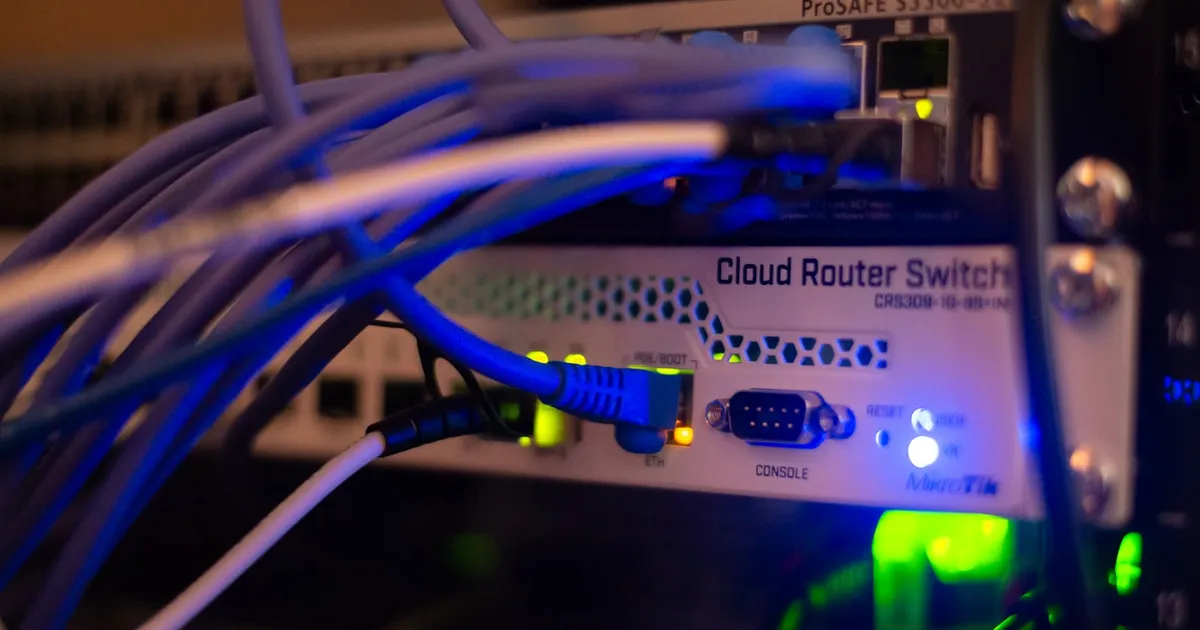
The hardware that moves data inside AI data centers has become the next front in the US–China technology fight. According to a Reuters report published August 4, 2026, the Trump administration is drafting a rule that would ban US imports of new Chinese-made optical transceivers — the small modules that convert electrical signals into pulses of light so information can travel across fiber-optic cables at high speed inside a data center.
The report, citing people familiar with the matter, says the Federal Communications Commission is leading the effort and that officials hope to publish the measure this year, at which point it would take effect. The sources cautioned that the FCC could still modify the proposal or abandon it. Neither the FCC nor the White House confirmed the specifics.
What the rule would target
Optical transceivers are unglamorous but essential. Every large AI training cluster is really a network problem: tens of thousands of accelerators have to exchange data constantly, and the links between racks and rows are increasingly optical rather than copper. As cluster sizes grow, the number of transceivers grows with them — a single large AI build can consume hundreds of thousands of the modules.
The draft rule, as described, focuses on new imports of Chinese optical transceivers rather than a broader sweep of finished networking gear, though earlier reporting suggested officials also weighed restrictions touching servers and storage devices. The stated rationale is national security: US officials have expressed concern that Chinese-made equipment embedded deep in domestic data centers could be used to access data, install malicious software, or disrupt operations. Regulators have applied similar logic before, from telecom equipment to undersea cables.
The move fits a widening pattern of restrictions we have tracked, from US export licenses governing which AI chips can ship to China to Beijing’s own countermeasures. What is notable here is the direction of travel: earlier controls mostly limited what US firms could sell to China. This one would limit what US data centers can buy from China — a reminder that the dependency runs both ways.
The company in the crosshairs
The rule would land hardest on Zhongji Innolight, the Chinese optical-transceiver champion that supplies the biggest names in AI infrastructure. By most estimates, Innolight holds roughly 27% of the global market for data-center optical transceivers, making it the single largest player in a critical link of the AI supply chain.
The timing is brutal for the company. Innolight was added to the US Department of Defense’s Section 1260H list of Chinese military-linked companies in June 2026, a designation that does not by itself ban commerce but signals heightened scrutiny. Then, on July 30, the firm completed a blockbuster Hong Kong IPO that raised about $6.81 billion — the city’s largest listing since Alibaba’s 2019 secondary offering — pricing shares at HK$980. The stock slipped roughly 5% on its trading debut as geopolitical risk weighed on sentiment, and just five days later the Reuters report on the draft ban emerged, threatening access to one of Innolight’s largest customer bases. The company also carries meaningful customer concentration, with a large share of revenue tied to a handful of US hyperscalers.
The market moved immediately
Public markets did not wait for a final rule. On August 4, shares of US and Western optical-component makers rallied on the expectation that a ban would redirect orders their way. According to market reports, Applied Optoelectronics (AAOI) jumped roughly 16–17%, Coherent (COHR) climbed about 11–13%, Lumentum (LITE) gained in the high single digits to low teens, and Corning (GLW) rose about 8%. Smaller photonics names, including POET Technologies, moved as well.
The logic is straightforward. If hyperscalers can no longer buy new Chinese transceivers, they must source the modules — and the lasers, optics, and packaging inside them — from suppliers outside China. Coherent, Lumentum, and Applied Optoelectronics are among the most obvious beneficiaries, alongside component suppliers like Corning that sit upstream in the optical stack.
That enthusiasm arrives against a jumpy tape. The optical rally came only days after a broad sell-off in AI chip stocks erased more than $1 trillion in market value, a swing that underscored how sensitive the sector has become to any shift in the AI-infrastructure narrative — bullish or bearish.
The catch for buyers
A ban that helps US suppliers does not automatically help US data-center operators. The hyperscalers building out AI capacity — the same companies driving the record capital-expenditure boom — rely on a global supply chain tuned for cost and volume. Chinese transceivers are competitive precisely because they are inexpensive and available at scale.
Cutting them out has three near-term consequences. First, cost: alternative suppliers can command higher prices, especially if demand spikes as everyone scrambles for compliant hardware at once. Second, supply: Western capacity cannot expand overnight, and transceiver manufacturing depends on its own specialized inputs. Third, timing: retrofitting sourcing plans mid-buildout can slow deployments at a moment when operators are racing to stand up clusters. Those frictions feed directly into the economics of running a data center, where the cost and availability of every component compounds across hundreds of thousands of units.
There is also the question of scope and enforcement. Transceivers are assembled from globally sourced parts, and “Chinese-made” is not always a clean line. A rule narrow enough to be enforceable may leave gaps; one broad enough to close them may sweep in more of the supply chain than intended.
What it means
A US ban on Chinese optical transceivers would be a small-sounding rule with outsized reach, because the component sits at a chokepoint of the entire AI buildout.
Who wins. Western photonics suppliers — Coherent, Lumentum, Applied Optoelectronics, and upstream players like Corning — stand to capture share and pricing power if hyperscalers are forced to switch. The market has already begun pricing that in. Domestic and allied transceiver manufacturing gets a policy tailwind of the kind chipmakers have enjoyed from reshoring incentives.
Who loses. Zhongji Innolight is the clearest casualty: a newly public company with a dominant global position, a Pentagon designation, and now the threat of losing access to its most important market — all within weeks. US hyperscalers are exposed too, facing higher component costs and supply-chain disruption at the worst possible time. And the broader lesson is uncomfortable: the AI supply chain is more entangled with China than the headline chip-export debate suggests.
What to watch. First, whether the FCC actually publishes the rule this year, and how broadly it is written — networking-only, or servers and storage too. Second, the price signal: if compliant transceiver prices spike, expect it to surface in hyperscaler capex guidance. Third, retaliation risk — Beijing has its own leverage over rare earths, packaging, and materials the West needs. Fourth, whether Innolight can redirect volume to non-US customers fast enough to offset the loss. The AI boom has been sold as a story about chips and models. Increasingly, it is a story about who controls the humble parts in between.
Keep reading
 Kurumi · · 6 min read
 Gimlet Labs Raises $300M at $3B for Inference Cloud
Gimlet Labs raised $300M at a $3B valuation in a Series B led by a16z to scale its multi-silicon inference cloud for agentic AI. The backers, the tech, the stakes.
 Kurumi · · 6 min read
 Broadcom Q3 2026 Earnings: AI Chips Triple, Stock Dips
Broadcom's fiscal Q3 2026 revenue hit a record $29.6B as AI chip sales more than tripled to $16.7B, but light Q4 guidance sent the stock lower.
Kurumi · · 5 min read Broadcom Q3 2026 Earnings Preview: AI Chips in Focus
Broadcom reports fiscal Q3 on September 2 with AI semiconductor revenue guided to $16 billion. Here's the setup, the numbers, and what to watch.