Chip Stocks Sell Off Again Ahead of Big Tech Earnings
Chip stocks fell again July 27 as the SOX slid about 4% and money rotated into the Dow — a peak-cycle test right before Big Tech's earnings week.
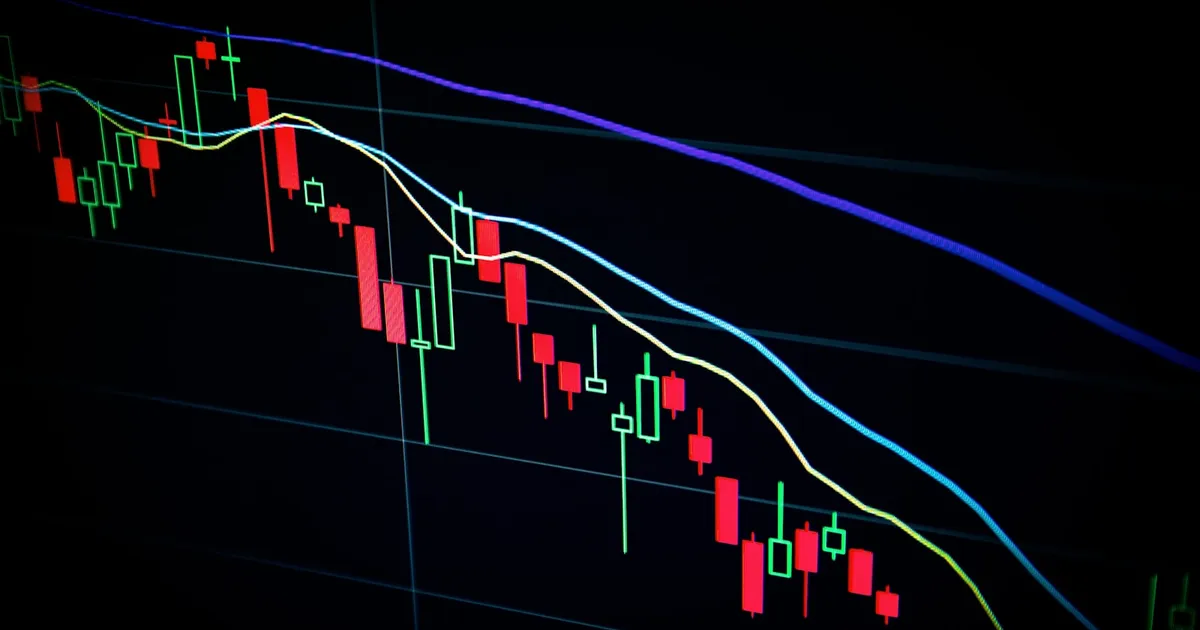
Semiconductor stocks slid for a second straight session on Monday, July 27, 2026, deepening a pullback that has quietly become one of the sharpest of the year even as the broader market held near records. The PHLX Semiconductor Index (SOX) fell roughly 4%, its second consecutive drop of that size, and now sits about 23% below its June 22 closing high. The move landed at an awkward moment: two days before four of the five megacaps that carry the AI trade report earnings, and the same afternoon the Federal Reserve begins a two-day meeting.
The pain was concentrated exactly where the gains had been. The VanEck Semiconductor ETF (SMH) lost more than 2%, Advanced Micro Devices dropped about 5%, Teradyne fell roughly 4%, and Micron Technology shed about 2%. The Information Technology Select Sector SPDR (XLK) — the broad tech sleeve — declined 1.4%, making technology the worst-performing corner of the S&P 500 on the day.
The index divergence tells the story
What makes July 27 notable is not the size of the chip decline on its own, but the split screen behind it. As semiconductors fell, the Dow Jones Industrial Average rose 262.83 points, or 0.51%, to close at 52,210.08. The S&P 500 was essentially flat, adding 0.02% to finish at 7,413.18. The Nasdaq Composite slipped 0.18% to 24,932.08.
That pattern — a rising Dow, a flat S&P, and falling chips — is the signature of a rotation, not a liquidation. Money didn’t leave the market; it moved. Real estate and materials were the day’s biggest sector gainers, and capital flowed toward industrials, financials, and defensive names while the most crowded, most expensive part of the tape cooled. Analysts have been tracking the trend for weeks: one widely circulated chart pegged the migration out of chips and into the rest of the mega-cap complex at more than $3.2 trillion, a shift large enough to leave the S&P 500 roughly flat over a stretch that saw wild moves underneath the surface.
It is the same mechanism that drove the early-July chip rout, when the SOX lost 6.7% over two sessions and the Dow marched to a record on the same days. Three weeks later, the release valve is working the same way — but the cumulative damage to semiconductors has grown, and the calendar ahead is far more dangerous.
Why the second leg is different
The July 3 selloff had a clear external trigger: a plunge in South Korean memory names that dragged the Kospi down 7.9% and fed back into U.S.-listed chip and equipment stocks. This week’s decline is quieter and, in a way, more telling. There was no single shock. Instead, the market is repricing a group that had run too far, too fast, into an earnings gauntlet that could either validate the AI capital-spending thesis or expose its limits.
The immediate worry is overcapacity. After eighteen months of hyperscalers racing to secure GPUs, memory, and data-center capacity, investors are increasingly asking whether the buildout has front-run demand. That question sharpened after Alphabet’s July 22 report, which beat on revenue and showed Google Cloud growing 82% — and still sent the stock lower, because management lifted capital-expenditure guidance into a $195 billion–$205 billion range and signaled more increases into 2027. The takeaway rippled straight into the chip complex: if the buyers of AI silicon are spending more without yet showing the payoff, the sellers of that silicon are priced for a level of demand that has to keep accelerating.
The peak-cycle framing has taken hold alongside it. Semiconductors are a famously cyclical industry, and after the SOX nearly doubled during the second quarter, some investors have begun to treat elevated data-center orders as a top rather than a floor. Memory sits at the center of that debate. High-bandwidth memory has been the tightest link in the AI supply chain and the highest-beta proxy for AI sentiment — which is why Micron’s stock keeps swinging in both directions and why it fell again Monday even without company-specific news.
The setup into the biggest week of the year
The timing is what elevates a routine pullback into something the whole market is watching. The reporting calendar front-loads the AI trade’s biggest questions into roughly 48 hours. Microsoft and Meta Platforms report after the close on Wednesday, July 29; Apple and Amazon follow after the close on Thursday, July 30. Layered on top, the Federal Open Market Committee meets July 28–29, with the policy decision due Wednesday afternoon — hours before the first megacap prints. The collision of a rate decision and four reports worth well over $12 trillion in combined market value is, as we wrote in the week-ahead preview, the single most consequential stretch of the 2026 market calendar.
For chip investors, the read-through runs through capital budgets. Microsoft, Meta, and Amazon are three of the largest buyers of AI accelerators on earth. Their commentary on 2026 and 2027 capital spending — whether it climbs, holds, or shows any hint of moderation — will do more to set the direction of semiconductor stocks over the next quarter than any chipmaker’s own guidance. A collective message that spending keeps rising would hand the sector a reason to stabilize; any softness, or any sign that the returns on that spending are lagging, would confirm the overcapacity fear that is already pulling the group lower.
The efficiency subplot cuts underneath all of it. Part of what has driven the rotation is a growing belief that the marginal dollar of AI value is shifting from raw hardware toward cheaper, more specialized inference — the same thesis that has powered the rotation from AI hardware toward software and lifted a wave of infrastructure startups selling lower-cost model serving. If enterprises can get frontier-adjacent performance without buying the newest, most expensive GPUs, the demand curve for the highest-end silicon flattens — and the stocks that priced in years of uninterrupted GPU scarcity have the most to lose.
What it means
A 23% drawdown from a June peak, after a quarter that nearly doubled the sector, is a correction inside a bull market rather than the end of one. But the character of this second leg matters. The July 3 selloff was a foreign shock digested over a holiday weekend. This one is domestic, orderly, and driven by positioning and doubt — the market steadily de-risking the most crowded trade it owns, right before the events that will settle the argument.
Who feels it most. The high-beta memory and equipment names carry the sharpest swings in both directions, and AMD, Teradyne, and Micron showed it again Monday. The Dow’s simultaneous strength confirms there is a deep, willing bid for everything outside the AI trade — industrials, financials, real estate, materials — which means the rotation can continue without dragging the whole index down.
What to watch next. Three things, in order. First, hyperscaler capital-expenditure guidance from Microsoft, Meta, and Amazon on July 29–30 — the single most important input for chip demand, and the number the market will grade above revenue or profit. Second, the Fed, whose Wednesday decision and press conference land in the same window; any surprise on the policy path would hit the highest-multiple stocks first, and that is precisely where semiconductors sit. Third, the breadth of the rotation — whether money keeps flowing calmly into defensives, which signals a healthy repricing, or whether the selling starts to spill into the broader index, which would signal something worse.
The deeper question is unchanged from three weeks ago, only more urgent: is AI demand durable enough to justify valuations that assume years of uninterrupted growth, and has the buildout gotten ahead of it? The market has now flinched twice in a single month. By Thursday night, four of the companies actually writing the checks will have told us whether the flinch was noise — or the start of the repricing the chip tape has been bracing for.
Tagged
Keep reading
 Kurumi · · 5 min read
 Marvell Q2 Earnings: Record $2.74B, Raised Guidance
Marvell posted record Q2 FY2027 revenue of $2.74B on a 46% data center surge, raised its outlook again, and guided Q3 to $3.15B. The numbers and what they mean.
 Kurumi · · 5 min read
 Nvidia AI Server Prices to Rise 15%+ on Memory Costs
Nvidia's server builders have told Microsoft, Google and Oracle that Vera Rubin and Grace Blackwell system prices will climb more than 15% from early 2027 as memory costs soar.
Kurumi · · 5 min read Etched Raises $700M at $21B Valuation From Jane Street
Etched raised $700M led by Jane Street at a $21B valuation, doubling in a month, and shipped its first Sohu inference rack. The deal and the risks.