Qualcomm AI200 and AI250: A Memory-First Bet on Inference
Qualcomm's rack-scale AI200 and AI250 accelerators bet on huge, cheap LPDDR memory instead of HBM to win AI inference. How the design works and who's buying.
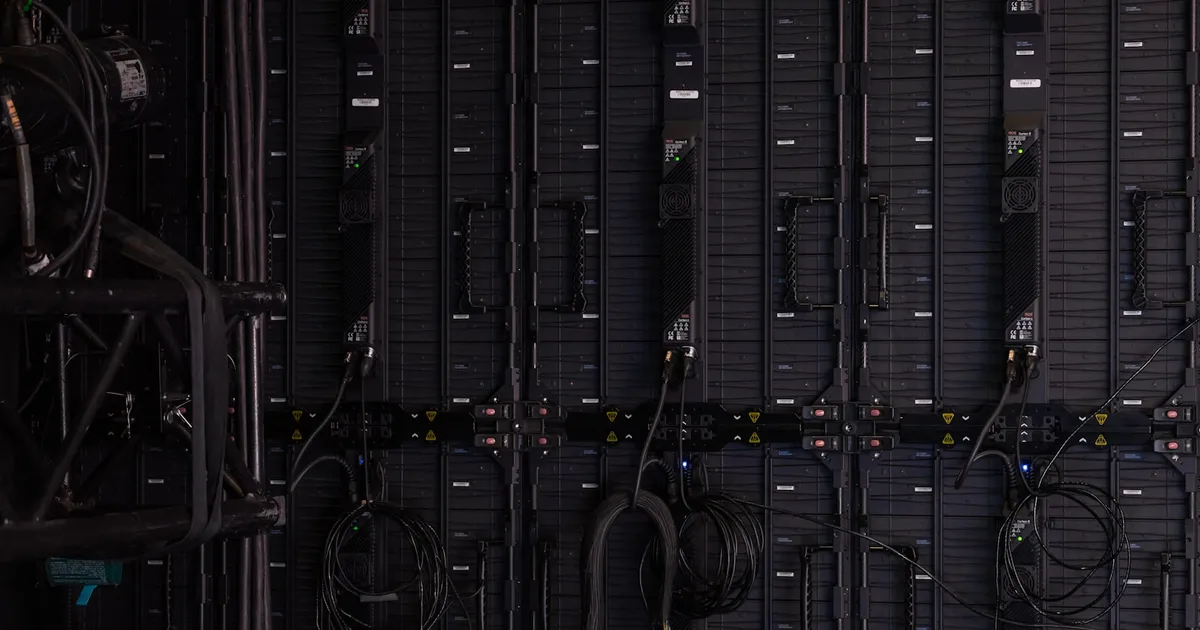
The Qualcomm AI200 and AI250 are rack-scale AI accelerators aimed at one job: running trained models — inference — as cheaply as possible per query. Announced in October 2025, the AI200 is slated for commercial availability in late 2026 with the AI250 to follow in 2027, and the headline design choice is contrarian. Where Nvidia and AMD accelerators lean on expensive, supply-constrained HBM stacks, Qualcomm straps 768 GB of LPDDR to a single card — the same memory class as a laptop, in a data center part. That one decision explains most of what these chips are and aren’t for.
What was actually announced
The products span three levels of packaging: accelerator cards, servers, and full racks. A rack draws up to 160 kW, uses direct liquid cooling, and connects with deliberately boring interfaces — PCIe to scale up within a system, standard Ethernet to scale out across racks. There is no proprietary interconnect fabric to buy into, which is itself a pitch to cost-conscious buyers.
The compute lineage is unusual: the NPU architecture descends from Hexagon, the AI engine Qualcomm has shipped in phone and laptop chips for years (the same line rated at 80 TOPS in current Snapdragon laptops). Qualcomm’s wager is that a decade of squeezing inference into battery-powered devices — aggressive quantization, low-precision math, power discipline — is exactly the skill set that matters when data center customers start counting watts per token.
Why so much memory?
Inference economics are increasingly memory economics. A large model must sit somewhere near the compute, and serving it at scale means holding not just the weights but growing key-value caches for every concurrent conversation. HBM delivers spectacular bandwidth but is costly, power-hungry, and one of the tightest supply bottlenecks in the industry.
Qualcomm’s answer is capacity over raw bandwidth: 768 GB per card of commodity-class LPDDR means an entire large model — or several — fits on one card without sharding across a fleet of accelerators. Fewer cards per model means less inter-chip traffic, simpler serving topologies, and a lower bill. The trade-off is real: LPDDR can’t match HBM bandwidth per package, which is why this design targets throughput-oriented serving rather than winning single-query latency records — and why nobody positions it for training.
The AI250, a year behind, is the more interesting chip technically. It introduces a near-memory computing architecture that Qualcomm says delivers over 10× higher effective memory bandwidth by moving compute closer to where the data lives — a direct attack on the exact weakness of the memory-first design.
The software question
Every Nvidia challenger dies or lives on software, and Qualcomm knows it. The stack supports the mainstream frameworks and inference engines, ships an Efficient Transformers Library and an AI Inference Suite, and promises one-click deployment of Hugging Face models. Disaggregated serving and confidential computing are in the feature list, and the company has committed to an annual product cadence, with a third generation targeted for 2028.
The strategic follow-up came in June 2026, when Qualcomm announced it was acquiring the AI-software company Modular — a serious inference-stack play aimed at the portability layer above the hardware. That, plus the Meta and Microsoft commitments announced the same week, is the company’s answer to “why would anyone port off CUDA”: make the porting cost someone else’s problem and put anchor customers on stage.
Who’s buying
The first named customer is Humain, Saudi Arabia’s state-backed AI company, which plans to deploy 200 megawatts of Qualcomm-based capacity starting in 2026 — on the order of 1,200+ racks at 160 kW each — to serve inference workloads regionally and beyond. Qualcomm is also opening an AI engineering center with Humain in Riyadh. It’s a real anchor deal with a strategically motivated buyer; the harder validation — hyperscalers putting these racks in mainstream clouds — began to materialize at Qualcomm’s June 2026 investor event, though volume deployments remain ahead of it.
The honest scorecard
- For it: inference is the fast-growing, less-locked-in half of the AI compute market; the memory-capacity approach maps to where serving costs actually live; power efficiency is a genuine Qualcomm competence; and data center economics now punish every wasted watt.
- Against it: Nvidia’s software gravity is enormous, AMD is chasing the same inference dollars with HBM-heavy parts and a two-year head start in credibility, and Qualcomm has to prove it can support data center customers at data center service levels — a different business than shipping phone chips.
The takeaway
The AI200 and AI250 are a focused bet, not a frontal assault: skip training, skip the bandwidth arms race, and win inference on cost per token by putting 768 GB of cheap memory next to an NPU bred for efficiency. The rack design is deliberately standard — PCIe up, Ethernet out, liquid cooling — and the AI250’s near-memory architecture addresses the design’s own weak point a year in. Whether it works comes down to software and service, not silicon; the Humain deployment and the hyperscaler names that surfaced in June 2026 will be the proof either way.
Keep reading
 Chisato · · 5 min read
 OpenAI Buys Tens of Thousands of Macs for AI Agents
OpenAI reportedly bought tens of thousands of Mac minis and Studios to train computer-use agents, while Anthropic rents Apple silicon via AWS.
 Chisato · · 6 min read
 Apple Mac Studio M5 Ultra and Mac mini M6: Specs, Price
Apple refreshed the Mac Studio with M5 Max and M5 Ultra and the Mac mini with M6, adding up to 512GB of unified memory and big on-device AI gains. What to know.
 Chisato · · 4 min read
 What Is a TPU? Tensor Processing Units Explained
A TPU is a chip built specifically for the matrix math behind neural networks, using a systolic array instead of a general-purpose GPU pipeline.