DeepSeek AI Chip: Why Nvidia Stock Slipped
China's DeepSeek is reportedly designing its own AI inference chip to cut reliance on Nvidia and Huawei. Here's what's confirmed and why Nvidia shares fell.
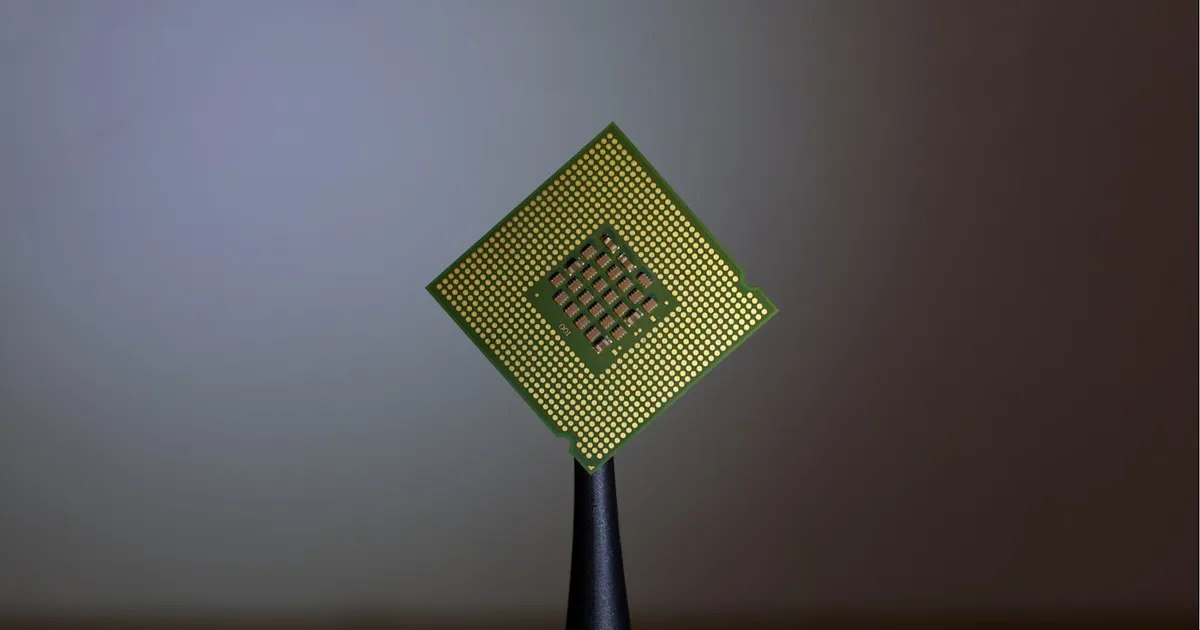
The company that shook the AI world with a low-cost model is now going after the most expensive part of the stack: the silicon. According to reporting first published on July 7, 2026, Chinese AI lab DeepSeek is quietly developing its own AI inference chip, an effort aimed at reducing its dependence on both Nvidia and China’s domestic champion Huawei. Nvidia shares slipped on the news, falling as much as 2% before stabilizing.
What’s reported
Sources describe an effort that began roughly a year ago and remains at an early stage. DeepSeek is said to be in discussions with chip-design, foundry, and memory companies, and has stepped up recruitment of chip-design engineers — hiring done privately, without public job postings. The company has not confirmed a tape-out, a manufacturing partner, or a ship date.
Crucially, the chip targets inference, not training. Inference is the stage where a trained model actually generates responses for users; training is the far more compute-intensive process of building the model in the first place. That distinction matters. Training still demands the largest, most interconnected clusters of high-end GPUs, where Nvidia’s hardware-plus-software moat is deepest. Inference is a different, and increasingly larger, market — and one where purpose-built silicon can be cheaper and less power-hungry than a general-purpose GPU.
DeepSeek is not alone in seeing that opportunity. Purpose-built inference accelerators are one of 2026’s clearest hardware trends, from Qualcomm’s AI200 and AI250 data-center parts to the custom chips hyperscalers are commissioning. As more of the industry’s compute shifts from training models to running them, reasoning models that generate long chains of tokens make inference efficiency a first-order cost problem.
The money behind it
DeepSeek is attempting this from a position of unusual financial strength for a startup. The company recently raised roughly RMB 51 billion, valuing it at about RMB 400 billion (on the order of $52–59 billion). Founder Liang Wenfeng personally contributed around RMB 20 billion — roughly $2.9 billion — making him the single largest investor in the round, alongside names including Tencent, NetEase, and JD.com.
That war chest is funding a broader shift. DeepSeek is reportedly moving from a light-asset model toward building self-owned data centers and expanding headcount to support its own infrastructure. Designing an in-house chip is the logical extreme of that vertical-integration push: control the model, control the serving stack, and — eventually — control the hardware it runs on.
The obstacle is manufacturing, not design
Here is the catch, and it is a big one. Designing a competitive inference chip is hard; manufacturing one inside the current export-control regime may be harder still.
U.S. rules bar Chinese chip designers from accessing the most advanced overseas foundries — the leading-edge process nodes at TSMC and Samsung that make a chip genuinely competitive on performance-per-watt. Separately, U.S. curbs have cut China’s access to high-bandwidth memory (HBM), the stacked memory that sits next to an AI accelerator and feeds it data. And HBM is the bottleneck for inference specifically: a chip is only as fast as the memory bandwidth serving its weights. Without leading-edge HBM, even a well-designed inference part can be throttled before it leaves the drawing board.
This is why analysts read Nvidia’s 2% dip as a measured reaction rather than a panic. A Chinese design house announcing intent is not the same as a Chinese design house shipping volume silicon on a competitive node with adequate memory. The design talent and the capital are clearly there; the supply chain is the wall.
Why the market cares anyway
If manufacturing is such a hurdle, why did Nvidia move at all? Because the strategic signal outweighs the near-term threat.
DeepSeek is the most influential AI lab in China and one of the most closely watched anywhere. When it commits engineers and billions of RMB to escaping Nvidia and Huawei, it tells the market that even the labs most dependent on Nvidia are actively working to need it less. That is the same anxiety running through every custom-silicon story of the past year, from hyperscaler in-house accelerators to the Chinese-chip training runs that other domestic labs have demonstrated. Nvidia’s valuation rests on the assumption that its customers have no viable alternative; each credible in-house effort chips, slightly, at that assumption.
There is also a China-specific dimension. Beijing has poured resources into domestic AI infrastructure, and a homegrown DeepSeek inference chip — even a modest one — would advance the national goal of a self-sufficient AI stack. It would also reduce DeepSeek’s reliance on Huawei, whose Ascend line has been the default domestic option but comes with its own supply and performance constraints. A DeepSeek that controls its own inference silicon is less exposed to both American export policy and a domestic rival.
What it means
Treat this as a statement of intent, not a shipped product. DeepSeek has the capital, the model expertise, and now apparently the engineering ambition to build inference silicon — but the export-control regime stands between design and volume manufacturing, and nothing in the reporting suggests that wall has been cleared.
Who’s exposed: Nvidia, at the margin and over the long term, not this quarter. The training franchise is safe for now; the risk is that inference — the larger, faster-growing market — gradually opens to purpose-built competitors, and DeepSeek building its own is one more data point that the trend is real. Huawei is arguably more exposed near-term, since a self-sufficient DeepSeek is a lost domestic customer.
Who benefits: China’s push for a vertically integrated, sanctions-resilient AI stack, and any foundry or memory supplier — inside or outside export restrictions — that can legally participate.
What to watch: whether DeepSeek names a foundry partner and a process node; how it solves the HBM problem, which is the single hardest technical constraint; and whether the chip is meant purely for DeepSeek’s own serving or for external sale. The line between “we run our own models cheaper” and “we sell chips to everyone” is the line between an internal cost optimization and a genuine threat to Nvidia’s inference business. For now, DeepSeek is firmly on the first side of it — but it has told the world which direction it’s walking.
Tagged
Keep reading
 Chisato · · 6 min read
 US Moves to Block China's Remote AI Chip Access
The Commerce Department is drafting a rule to stop Chinese firms from renting banned Nvidia AI compute through data centers in third countries.
 Kurumi · · 5 min read
 Nvidia AI Server Prices to Rise 15%+ on Memory Costs
Nvidia's server builders have told Microsoft, Google and Oracle that Vera Rubin and Grace Blackwell system prices will climb more than 15% from early 2027 as memory costs soar.
Chisato · · 6 min read Nvidia Groq 3 LPX: $20B Inference Chip Goes Live
Nvidia's Groq 3 LPX inference chip is in full production and comes online in 2026, extending Vera Rubin for agentic AI. The specs, the deal, the stakes.