Nvidia Kyber Delay: What the 2028 Rack Slip Means
SemiAnalysis says Nvidia's Kyber NVL144 rack slipped to 2028 on a PCB midplane snag. Nvidia calls its roadmap 'intact.' Here's the report, the denial, and the stakes.
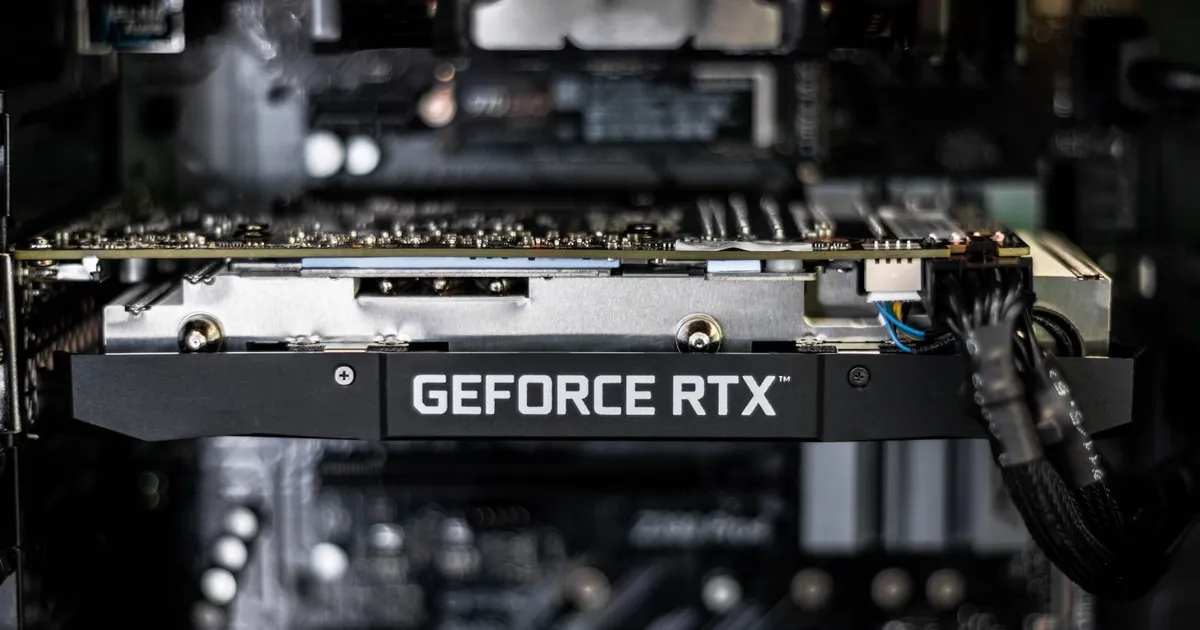
A single circuit board has become the most closely watched component in the AI supply chain. On July 6, 2026, the analyst firm SemiAnalysis reported that Nvidia’s next-generation Kyber NVL144 rack-scale system — the cabinet meant to house its Vera Rubin Ultra generation — has slipped from a planned 2027 debut to 2028, blaming manufacturing problems with a critical printed circuit board. Nvidia disputed the account, telling reporters its “roadmap is intact.” The clash sent Asian supplier stocks lower before Nvidia’s own shares recovered.
What SemiAnalysis reported
Kyber is Nvidia’s most ambitious packaging effort to date: a design that consolidates 144 of the company’s most powerful GPUs into a single rack-scale cabinet, wired together to behave as one giant accelerator. According to SemiAnalysis, the sticking point is the PCB midplane — the dense backplane board that carries signals and power between the system’s components.
That board, the firm said, is roughly a 78-layer design, among the most complex printed circuit boards ever attempted for a commercial computing product. SemiAnalysis described a cluster of intertwined engineering problems — signal integrity, power delivery, thermal design, and manufacturable layer counts — that together pushed production readiness beyond what Nvidia and its supply-chain partners could resolve on the original timeline. The result, per the report, is a delay of more than twelve months, moving volume availability to 2028.
Just as damaging, SemiAnalysis said Nvidia has cancelled a stopgap — a rack referred to as NVL72x2 that would have bridged customers to the full Kyber design — reportedly after customer pushback. If accurate, that leaves no proven alternative to widen Rubin Ultra’s scale-up in 2027, meaning the delay is not cushioned by a fallback product.
Nvidia’s denial
Nvidia moved quickly to rebut the report. A company spokesperson told Bloomberg the product roadmap is “intact,” pushing back on the characterization that its flagship rack had slipped a year. The company did not release a detailed rebuttal of the specific PCB claims, framing the SemiAnalysis account as speculation about a roadmap Nvidia says remains on track.
The market appeared to give Nvidia the benefit of the doubt. NVDA shares rose more than 1% on Monday, helped by the denial and by a well-timed Goldman Sachs note calling the valuation attractive. Goldman’s analyst pointed out that Nvidia trades at a forward price-to-earnings ratio of about 21.7 times — close to the average for the S&P 500 and far below the roughly 72x average the stock carried over the prior five years — arguing that AI infrastructure spending remains early and that there is ample room for growth.
Who felt the fallout
The immediate damage landed not on Nvidia but on its suppliers. Asian technology stocks tied to the Kyber supply chain fell after the report, as investors priced in a later revenue ramp for the connectors, boards, and assembly work the system requires. Attention also turned to the midplane’s component makers: reporting suggested Nvidia may be reworking its supplier lineup for the troubled board, with the connector business potentially shifting between vendors — a reminder that a delay at the system level reprices every company downstream of it.
That sensitivity is the point. Nvidia’s rack roadmap has become a load-bearing assumption for an entire ecosystem, and the chip-stock rout earlier this month showed how quickly sentiment in the group can turn. A credible report that the flagship product is a year late is exactly the kind of catalyst that moves suppliers before it moves Nvidia.
Why rack-scale is the hard part
The episode highlights a shift in where the difficulty now lives. For years, the hardest problem in AI hardware was the silicon itself. Increasingly, it is everything around the silicon — the packaging, the interconnect, the power delivery, and the boards that tie hundreds of chips into a single coherent machine. The Rubin platform is defined as much by how its parts are stitched together as by the GPUs at its core, and Kyber represents the extreme end of that integration.
A 78-layer midplane routing signals and power for 144 accelerators is a manufacturing problem at the edge of what is physically buildable at yield. Getting one to work in a lab is different from producing thousands reliably, and the gap between those two states is where roadmaps slip. The same pressure runs through the rest of the stack — the HBM4 supply race that feeds these systems with high-bandwidth memory is its own bottleneck, and every generation stacks more of these dependencies on top of one another.
What it means
Strip away the back-and-forth and two things are true regardless of who is right about the exact date. First, rack-scale integration is now the binding constraint on AI compute, not chip design — and constraints of that kind tend to produce slips, not surprises. Second, any wobble in Nvidia’s roadmap ripples through a supply chain and a stock market that have priced the roadmap as a near-certainty.
If SemiAnalysis is right, the delay creates an opening. A year without a full Kyber-class product at the top of Nvidia’s lineup is a year in which rivals can compete for the largest training clusters. It strengthens the case for AMD’s accelerator roadmap and for custom silicon from the hyperscalers, all of whom would welcome a gap at the frontier of rack-scale systems.
If Nvidia is right, the “roadmap is intact” line will be validated by shipping product, and Monday’s dip in supplier stocks will read as an overreaction to an analyst report. The company’s stock action — up despite the headline — suggests the market currently leans toward Nvidia’s version.
What to watch: concrete build and shipment milestones for Kyber and Vera Rubin Ultra over the next two quarters; any confirmed change to the midplane supplier lineup, which would corroborate that the board is the real problem; and whether the cancelled stopgap leaves customers scrambling for scale-up capacity in 2027. In a market where Nvidia’s calendar is treated as gospel, the most important number this week isn’t the stock price — it’s the layer count on a circuit board almost nobody had heard of a week ago.
Tagged
Keep reading
 Kurumi · · 5 min read
 Nvidia AI Server Prices to Rise 15%+ on Memory Costs
Nvidia's server builders have told Microsoft, Google and Oracle that Vera Rubin and Grace Blackwell system prices will climb more than 15% from early 2027 as memory costs soar.
 Kurumi · · 6 min read
 Chip Stocks Brace for Nvidia Earnings, Jackson Hole
Semiconductor stocks enter a decisive week caught between a 19-year high in long-term yields and rate-cut hopes, with Nvidia's report Wednesday the main event.
Kurumi · · 6 min read Nvidia Q2 FY2027 Earnings Preview: What to Watch
Nvidia reports Q2 fiscal 2027 results on August 26. The Street sees roughly $93–95B in revenue against $91B guidance. Here's what matters for the AI trade.