Google AI Overviews and the Zero-Click Search Problem
Fresh 2026 data shows AI Overviews now sit atop most Google searches, and clicks to the open web are collapsing. Here's what the numbers say and who is hit.
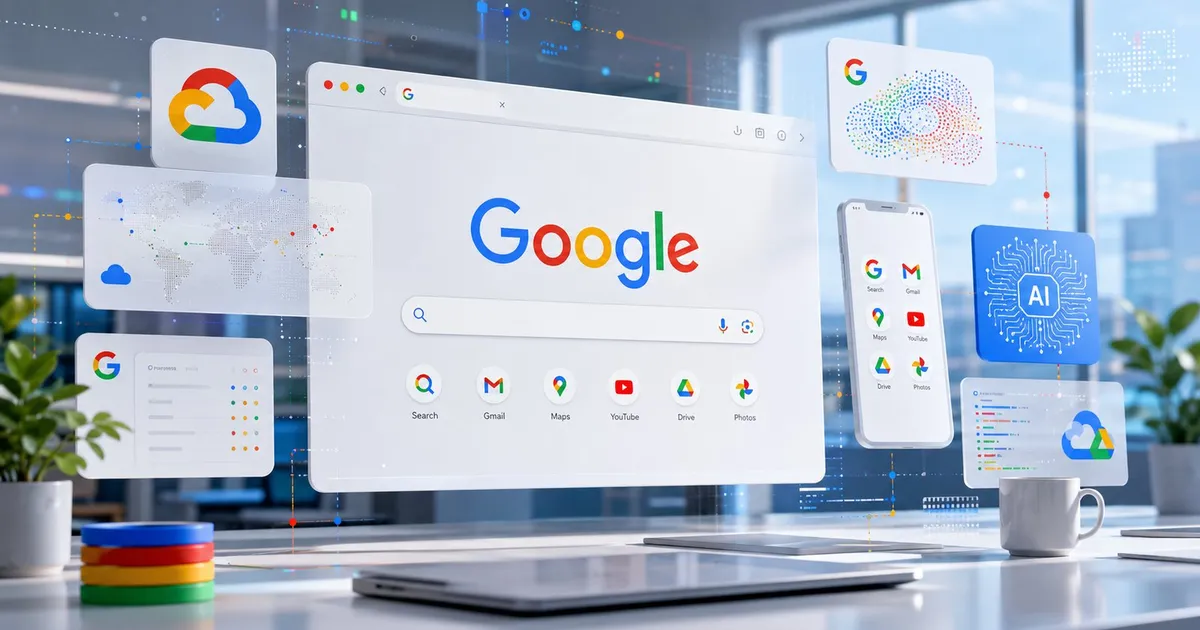
The web’s oldest bargain — you make a page, a search engine sends you visitors — is quietly breaking. A run of fresh 2026 data shows that Google’s AI Overviews now appear on the majority of searches, and that the share of queries ending without a single click to an outside site has climbed to levels that would have been unthinkable a few years ago. For the businesses, publishers, and independent sites that depend on search traffic, the numbers describe a structural shift, not a blip.
The numbers behind zero-click
Start with reach. AI-generated summaries now surface on roughly 55% of Google searches, according to recent tracking — meaning a synthesized answer sits above the traditional links more often than not. When those answers appear, users click through far less. Analysts estimate the organic click-through rate falls to around 8% when an AI Overview is present, compared with roughly 15% for a conventional results page. The answer is right there; fewer people feel the need to visit the source.
The aggregate effect is what the industry calls zero-click search — a query that Google resolves in place, sending no visitor onward. By 2026, the research firm SparkToro estimates that less than one-third of Google searches still send a click to the open web. For news-related queries the figure is starker: about 69% now end without a click, per Similarweb. That is a profound change in what a search engine does. For most of its history, Google’s job was to route you somewhere else. Increasingly, it is the destination.
The traffic that has already disappeared
This is not a forecast; the traffic loss is already showing up in publishers’ analytics. By one widely cited measure, Google search traffic to publishers fell about 33% globally in the year to late 2025, with US publishers hit harder at roughly −38%. Those are medians and aggregates; individual outcomes have been more brutal. Reporting tied to an antitrust filing pointed to click declines on the order of 58% for some categories of results once an AI answer was inserted.
The extreme cases are instructive. When an AI Overview surfaced above a visible link for one large news publisher, its desktop click-through rate reportedly cratered from around 25% to under 3% — a drop of nearly 90% — with mobile falling almost as far. Some content-heavy businesses have described losing the majority of their organic search traffic outright. The pain is not evenly distributed: sites whose value was “answer a common question concisely” are the most exposed, because that is exactly the job the AI Overview now does before the user ever scrolls.
Why this is happening now
The mechanism is the same one reshaping the rest of the software industry. Modern search answers are generated by large language models that read across many pages and synthesize a response, grounded in current web content through retrieval-augmented generation rather than the model’s training data alone. Google has leaned into this aggressively: its AI Mode in Search now runs on a fast Gemini model and, in the company’s own framing, represents the biggest change to Search in over two decades.
Two forces make the shift durable. First, the models keep getting better and cheaper; a capable summary now costs little enough to generate that Google can put one on a majority of queries without straining economics. Second, the newest reasoning-capable models handle multi-step questions well enough that users trust the synthesized answer for more than trivia. As the answers improve, the incentive to click through weakens further — a feedback loop that runs in one direction.
There is a further twist arriving with search agents — assistants built to monitor the web and act on a user’s behalf. When an AI agent does the browsing, the “reader” of a given page may increasingly be a model rather than a person. That reframes the entire question of who a website is written for.
Who wins and who loses
The clearest winner is Google itself. AI Overviews keep users inside Google’s surfaces, where its advertising business lives, and defend the core franchise against chat-first rivals that answer questions directly. For users, the experience is often genuinely more convenient: one good answer beats ten blue links when you just want a fact.
The losers are the sites on the other end of the bargain. Publishers built on search referrals, affiliate and how-to content, and any business whose funnel started with an organic click are watching a primary channel shrink. The uncomfortable irony is that the AI answers are synthesized from those same sites’ content — the model needs the open web to be useful, even as it reduces the web’s traffic. If enough sources go dark or wall themselves off, the quality of the answers eventually degrades, a tension the industry has not resolved.
How sites are adapting
The response taking shape in 2026 is less “beat the algorithm” and more “diversify away from it.” A few themes recur:
- Write to be cited, not just ranked. If a model is going to summarize your page, being the clearest, most authoritative source on a specific question raises the odds of being the one it quotes and links.
- Own the audience directly. Email lists, apps, communities, and brand searches route around the open-query funnel entirely. Traffic you don’t rent from a search engine can’t be intermediated away.
- Serve queries the answer box can’t. Deep, original, or interactive content — the kind a one-paragraph summary can’t replace — is where clicks still flow.
- Get the fundamentals right. Fast, well-structured pages remain easier for both crawlers and models to parse; the basics of Core Web Vitals and clean markup have not stopped mattering.
None of these fully replaces the volume that broad, top-of-funnel search once delivered. They are strategies for a smaller, more defensible slice of attention.
What it means
The zero-click shift is the most consequential change to the web’s economics in years, and the 2026 data suggests it has crossed from trend to baseline. With AI answers on a majority of searches and clicks flowing to fewer than a third of queries, the assumption that publishing good content earns search traffic no longer holds by default.
Who should worry. Any business whose model depends on cheap, high-volume organic clicks — thin content sites first, then the broader long tail of publishers that monetized informational queries. The declines already logged are large enough that “wait for it to recover” is not a strategy.
Who is more insulated. Brands with direct audience relationships, sites offering genuinely differentiated or interactive value, and anyone whose revenue was never a straight function of search volume. Being the trusted source a model cites is worth more than being the tenth link on a page few people now reach.
What to watch next. Three things. First, whether Google’s answers start linking sources more prominently — the single biggest lever it has over how much traffic survives. Second, how publishers’ licensing fights and content-access deals with AI companies evolve, since they determine whether the open web gets paid for feeding the answers. Third, the second-order effect: if referral traffic keeps falling, some sources will stop publishing, and the models that depend on fresh human-made content will feel it. Search made a bargain with the web a quarter-century ago. In 2026, it is rewriting the terms — and the sites on the other side are still working out what they get in return.
Keep reading

 The Lycoris Team · · 2 min read
 Getty Images and OpenAI Sign a Content Deal
Getty Images will surface its licensed library inside ChatGPT's search experience under a multi-year deal with OpenAI — another step from lawsuits to licensing.
 Chisato · · 2 min read
 Google Search's AI Mode Now Runs on Gemini 3.5
Google's AI Mode in Search now runs on Gemini 3.5 Flash and adds 24/7 agents that monitor the web for you — what it calls the biggest change to Search in 25 years.
 Chisato · · 5 min read
 Grouped-Query Attention (GQA) Explained: MHA vs MQA vs GQA
Grouped-query attention shares key and value heads across groups of query heads, shrinking the KV cache with little quality loss. GQA vs MHA and MQA.