What Is a Multi-Agent System? AI Agents Working Together
A multi-agent system splits a task across several specialized AI agents that coordinate instead of one agent doing everything. How they're structured.
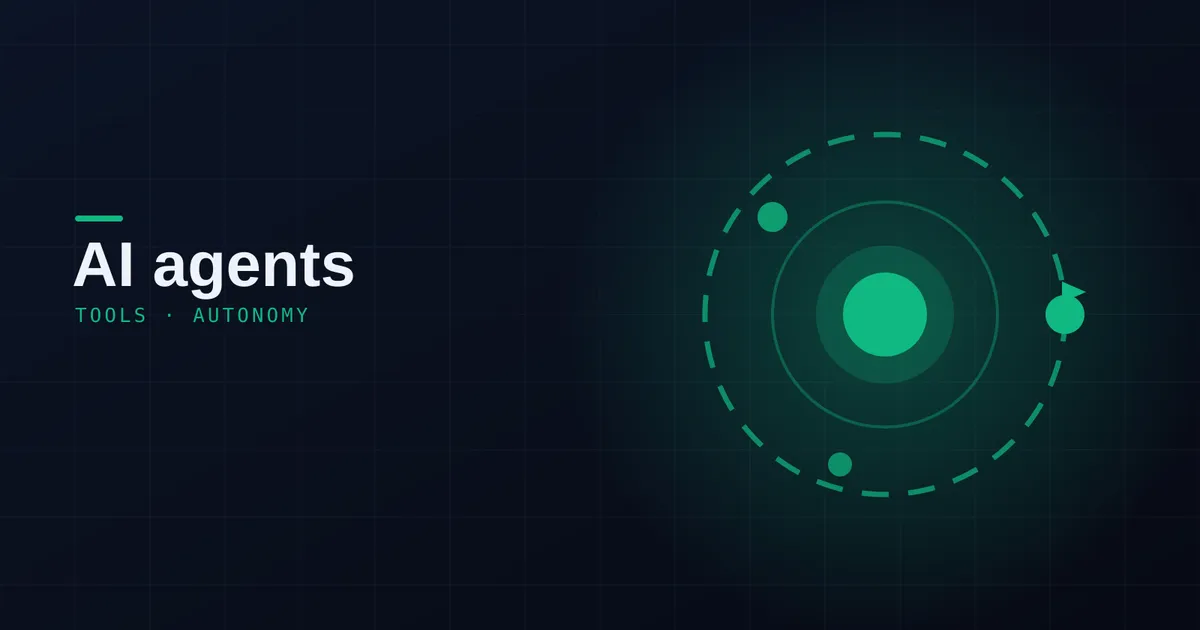
A multi-agent system splits a task across several specialized AI agents that each handle a piece of the problem and coordinate to produce a result, instead of relying on a single agent to plan, research, write, and check its own work end to end. The appeal is the same reason human teams specialize: a narrowly scoped agent with a focused prompt and a small toolset tends to perform more reliably on its slice than one generalist agent trying to hold the entire task in context at once.
Why split the work at all
A single AI agent can already use tools, plan multi-step tasks, and loop until a goal is met. The case for multiple agents shows up once a task grows large enough that one agent’s context window and attention start working against it — a long research task where the agent needs to both search broadly and reason carefully tends to do both worse than two agents doing them separately, because relevant details from early steps get diluted as the context fills up with everything since.
Splitting the task also allows for genuine parallelism. A research task with five independent sub-questions can run five agents concurrently instead of one agent working through them in sequence, cutting wall-clock time even though the total work is the same.
Common coordination patterns
Orchestrator-worker. One agent plans the task and delegates pieces to specialized worker agents, then collects and synthesizes their results. This is the most common pattern in practice — a lead agent decomposes “research X” into sub-questions, dispatches each to a worker, and writes the final synthesis itself once results come back.
Pipeline. Agents run in a fixed sequence, each one’s output feeding the next — a drafting agent writes, a fact-checking agent verifies claims against sources, an editing agent tightens the prose. Each stage has a narrow, well-defined job, which makes failures easier to isolate than in a single agent doing all three at once.
Debate or critique. Two or more agents review each other’s output — one produces an answer, another is prompted specifically to find flaws in it — before a final decision is made. This adversarial structure catches errors a single self-reviewing agent is prone to miss, since an agent grading its own work shares the same blind spots that produced the error in the first place.
Peer swarm. Agents with overlapping capabilities work on different parts of a problem without a strict hierarchy, communicating through a shared state or message log rather than reporting to a central orchestrator. This pattern is harder to control but scales better when the sub-tasks aren’t known in advance.
What’s actually being coordinated
Underneath any of these patterns, agents typically share information through one of a few mechanisms: direct message-passing between agents, a shared scratchpad or document each agent reads and writes, or a structured handoff where one agent’s final output becomes the next agent’s initial context. The Model Context Protocol standardizes how an individual agent connects to tools and data sources, but coordination between agents is a separate, still-evolving layer — efforts like the agent-to-agent standards emerging for enterprise use exist specifically to give agents from different vendors and frameworks a common way to hand off tasks.
Trade-offs against a single agent
Multi-agent systems aren’t free. Each agent-to-agent handoff is a place where context can be lost or misinterpreted — a worker agent that doesn’t receive enough context from the orchestrator will confidently produce a plausible-sounding but wrong answer, the same failure mode as LLM hallucination but now compounded across a chain of agents rather than contained in one. More agents also means more total tokens spent and more latency if any part of the pipeline is sequential rather than parallel, and debugging a multi-agent failure means figuring out which agent in the chain introduced the error, not just whether the final output was wrong.
A single, well-scoped agent with a good system prompt and the right tools is often simpler to build, cheaper to run, and easier to debug than a multi-agent system — and for tasks that genuinely fit in one agent’s context without diluting its focus, it’s usually the better choice. Multi-agent architectures earn their complexity on tasks that are either too large for one context window, benefit from genuine parallelism, or specifically need an adversarial or specialized second opinion that a single agent reviewing itself can’t reliably provide.
The takeaway
A multi-agent system trades the simplicity of one generalist agent for several specialized agents that coordinate through orchestration, pipelines, or peer communication — worthwhile when a task is too large or too parallel for a single context window, or when a specialized second opinion catches errors self-review would miss. The complexity cost is real: every handoff between agents is a place context can be lost, so the pattern earns its keep only when the task genuinely benefits from splitting, not by default.
Keep reading
 Chisato · · 4 min read
 What Is Context Rot in LLMs?
Context rot is the drop in an LLM's accuracy and reliability as the amount of text in its context window grows, even when the window technically fits it.
 Chisato · · 5 min read
 LLM Observability: Tracing AI Agents in Production
LLM observability traces every prompt, tool call, and token spent across an agent's run, turning an opaque chain of model calls into something debuggable.
 Chisato · · 6 min read
 Grok Voice Think Fast 2.0: Pricing, Specs, Default Date
xAI's Grok Voice Think Fast 2.0 becomes the default grok-voice-latest on Aug 5, with an 82.9% speech-quality score and $0.08/min pricing. What changed.